What is a New York Medicaid Managed Long Term Care Plan?
A New York Managed Long Term Care (MLTC) plan helps eligible individuals who require ongoing long-term care services receive care while remaining in their homes and communities.
New York currently recognizes three principal MTLC models: Partial Capitation, Medicaid Advantage Plus (MAP), and the Program of All-Inclusive Care for the Elderly (PACE).
For personal injury attorneys reviewing Medicaid liens, the Partial Capitation model requires careful review.
When dealing with partial capitation arrangement, New York Medicaid generally makes a monthly risk-adjusted capitation payment to the MLTC plan to cover specified long-term care and ancillary services. The payment is not just a reimbursement for a particular physician visit or medical bill, but rather, it is a prospective payment associated with providing the covered benefit package to the enrolled Medicaid beneficiary.
That distinction can become critically important when Medicaid seeks recovery following a personal injury settlement.
What is an MLTC Capitation Payment?
In traditional Medicaid fee-for-service (FFS), a provider renders a covered service and Medicaid pays for that particular service.
Capitation works differently.
An MLTC plan receives a periodic payment associate with providing a defined package of covered services to an enrolled beneficiary. The amount paid to the plan therefore should not automatically be viewed in the same manner as an individual medical bill generated by an accident-related provider.
New York’s MLTC Partial Capitation Model Contract expressly separates services included within the capitated benefit from services excluded from capitation. Services excluded from the capitated benefit remain payable through Medicaid fee-for-service when the enrollee is otherwise eligible.
For lien resolution purposes, that creates an important question:
What services associated with the plaintiff’s injury were actually paid through the MLTC capitation arrangement, and what services were separately paid fee-for-service?
That question can have substantial financial consequences.
Which Services are Covered by MLTC Capitation?
The distinction is easier to understand by examining the services themselves.
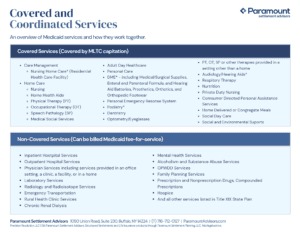
New York’s Partial Capitation Model Contract identifies services that may fall within the MLTC capitated benefit package, including:
- Care management;
- Nursing home care;
- Home nursing and home health aides;
- Personal care;
- Home-based physical, occupational, and speech therapy;
- Adult day health care;
- Durable medical equipment and certain medical supplies;
- Personal emergency response systems;
- Podiatry and dentistry;
- Optometry and eye glasses;
- Audiology and hearing aids;
- Respiratory therapy;
- Nutrition;
- Private-duty nursing;
- Consumer Directed Personal Assistance Services (CDPAS); and
- Certain meals, social day care, and social and environmental supports provided through care management.
What Services Are Generally Outside the Partial Capitation Payment?
For a Partial Capitation plan, the New York State Department of Health identifies a separate group of services as excluded from capitation and potentially payable fee-for-service. These include, among others:
- Inpatient and outpatient hospital services;
- Physician services;
- Laboratory services;
- Radiology;
- Emergency transportation;
- Chronic renal dialysis;
- Mental health services;
- Family planning services;
- Prescription and nonprescription drugs; and
- Certain other Title XIX State Plan services.
This distinction is one of the most important concepts for a personal injury attorney reviewing an MLTC Medicaid lien.
Download Our ‘Medicaid Covered and Coordinated Services’ Chart Below
Why Do Capitation Payments Matter in a Personal Injury Medicaid Lien?
A Medicaid lien may contain entries that look very different from an ordinary medical bill.
Counsel may see convention fee-for-service charges alongside recurring capitation (CAP) payments associated with the client’s MLTC enrollment.
Seeing those capitation entries on the lien does not, by itself, tell counsel whether the underlying accident-related services were provided through the MLTC benefit package.
The analysis should therefore go deeper.
A lien resolution review should determine:
- What accident-related services did the plaintiff actually receive?
- Which of those services fall within the MLTC capitated benefit package?
- Which accident-related services were instead paid separately through Medicaid fee-for-service?
- Is there evidence that an MLTC-covered service was actually furnished in connection with the accident during the month for which the capitation payment is being asserted?
That service-level analysis can reveal a significant discrepancy between the amount initially asserted and the amount properly attributable to injury-related Medicaid expenditures.
Real-World Example: $42,006.71 Medicaid Lien Reduced to $874.89
Consider the actual matter discussed in the original Paramount analysis.
The initial Medicaid lien asserted was $42,006.71.
The lien included both:
MLTC capitation payments, and Medicaid fee-for-service payments.
A detailed review of the payment history showed that the accident-related medical treatment was reflected as fee-for-service expenses rather than services paid through the MLTC managed-care benefit.
Paramount challenged the inclusion of the capitation payments on that basis.
Initial Medicaid Lien:
$42,006.71
Revised Medicaid Lien:
$874.89
Reduction:
$41,131.82
Percentage Reduction:
Approximately 97.9%
The result demonstrates why counsel should not assume that every amount appearing on an initial Medicaid lien is necessarily attributable to the underlying personal injury claim.
What Should Plaintiff’s Counsel Look for on an MLTC Medicaid Lien?
When a Medicaid lien contains recurring capitation payments, the lien should be evaluated rather than simply accepted at face value.
Counsel and the lien resolution professional should examine the payment history for several things:
- Recurring monthly CAP entries;
- Separately identified FFS payments;
- The dates of accident-related treatment;
- The type of service provided;
- Whether that service falls within the MLTC capitated benefit package; and
- Whether the payment data supports a connection between the capitation payment and the injury-related care.
The objective is not simply to determine whether the plaintiff was enrolled in MLTC.
The more useful question is:
What accident-related Medicaid benefits were provided, through which payment mechanism, and are the amounts asserted on the lien properly attributable to those benefits?
That is a much more precise lien resolution inquiry.
Why MLTC Liens Require More Than a Line-by-Line Medical Bill Review
Capitation makes MLTC lien analysis different from reviewing a conventional Medicaid payment history.
A large monthly payment may not correspond neatly to a single treatment date or provider invoice. It reflects the structure through which the managed-care plan is compensated for assuming responsibility for a defined package of covered services.
At the same time, Partial Capitation does not encompass every Medicaid service. New York expressly maintains a distinction between capitated services and services excluded from the capitation payment and payable separately.
That means effective lien review requires understanding of both sides of the system:
The plaintiff’s medical treatment and the Medicaid payment methodology used to fund it.
Failing to distinguish the two can result in counsel overlooking potentially challengeable amounts.
The Takeaway for New York Personal Injury Attorneys
A New York Medicaid lien involving Managed Long Term Care should not be evaluated solely by looking at the total amount asserted.
When MLTC capitation payments appear on the lien, counsel should determine whether accident-related services were actually provided through the capitated benefit package or whether the injury-related treatment was instead paid separately through Medicaid fee-for-service.
In the right case, that analysis can make a significant difference.
The Paramount matter discussed above began with an asserted lien of $42,006.71. After the payment methodology and accident-related services were analyzed, the lien was reduced to $874.89—preserving more than $41,000 of the settlement proceeds.